Those who made the journey north were not many in number, nor were they in good heart as they set out but they returned home delighted with a fine performance from their favourites. Crerand was dropped as he had to be after his half-time behaviour, and the forward line was totally rejigged with Gallagher back in his 1961 position of the right wing. At full back in came Ian Young and Tommy Gemmell. Tommy was so unfamiliar to the writer of The Evening Times that he was called “Peter”. He was making his debut although Ian Young had played a game or two before then. The two of them with the enthusiasm and the fearlessness of youth, tackled like tanks that day.
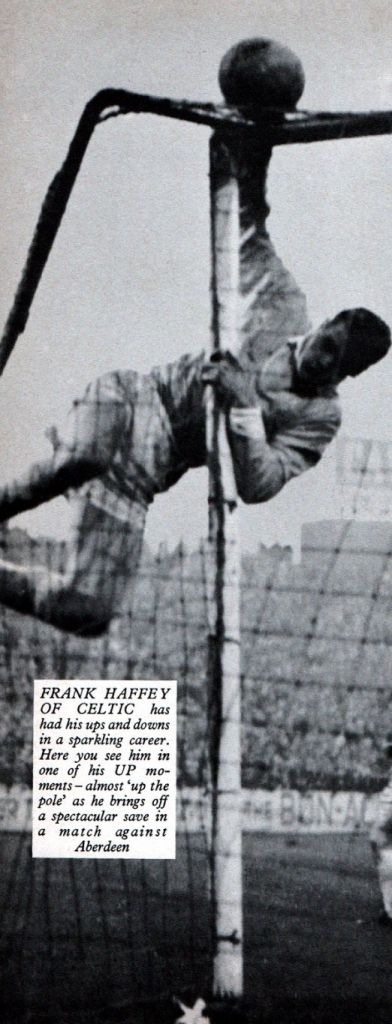
Celtic turned it on and beat Aberdeen 5-1, John Hughes scoring a hat trick and Bobby Craig getting two. It was an astonishing reversal of form from New Year’s Day and the small band of diehards made the most of it with an accordion helping supporters with their songs. Charlie played well that day, having a part in most of the goals, and it would have been nice to see how the team would have performed in the next few games with this formation. Sadly, however, it was only a temporary respite in the bad weather and the only other game to be played in January was the victory in the Scottish Cup at Brockville.
On other occasions this might have been a real banana skin for an unwary Celtic, but on this Monday night of January 28 before a small crowd on a heavily sanded pitch, Celtic won comfortably over a poor Falkirk side. The
game was threatened with ice, snow and then fog, but at 5.00 pm the referee Mr Barclay of Kirkcaldy declared the pitch playable. Once again there was no Pat Crerand but his replacement John McNamee played splendidly and
Celtic ran out 2-0 winners, the second goal coming late in the game from a Gallagher shot after a fine move involving several Celtic players.
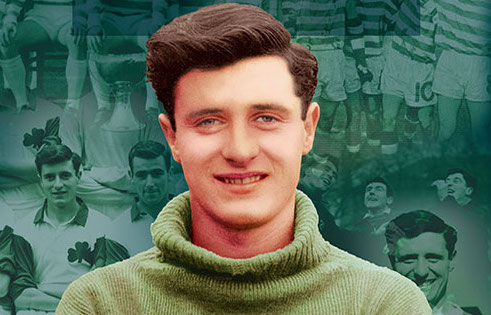
This victory put Celtic into the next round with a game against Hearts at Parkhead. It was a potential thriller but the big freeze meant that it could not be played until March. By this time, things had changed totally with the transfer of Pat Crerand to Manchester United, a move which caused tremendous distress to all concerned, not least one feels to Pat himself. It happened on 6 February. There had been some speculation for some time, particularly when Crerand was not in the team for the Falkirk Scottish Cup tie. Sources disagree about who approached who first, but on Wednesday 6 February Pat flew to Manchester, met Matt Busby at 10.00 am and was a Manchester United player by 10.30 am.
This meant that Pat’s last game had been the tragic New Year Day game at Ibrox. Gallagher was sad about all this, because even if Celtic had won two games since then without Crerand, only a fool would argue that the team did not suffer because of the transfer of a player of Crerand’s undoubted ability. As well as being cousins through marriage, Pat and Charlie, both Gorbals boys, were good friends, and it hurt Charlie that Pat would no longer be around.
The support was totally devastated. Pat Crerand had been the hero. Pictures of him, usually one from The Evening Citizen in black and white, but with green stripes painted on amateurishly so that the newspaper could claim that this was a “colour” photograph, adorned the walls of all supporters. These were now torn down with ferocity and anger by tearful fans to the bafflement and disquiet of their mothers. His name was now not to be mentioned – and yet it was, with the picture in The Scottish Daily Express of Pat leaving Celtic Park, head bowed with a holdall in his hand, trying to tell everyone how sad he was to leave. It was presumably staged for the benefit of the camera, but it remains an iconic image of this particularly desolating time of Celtic’s history.
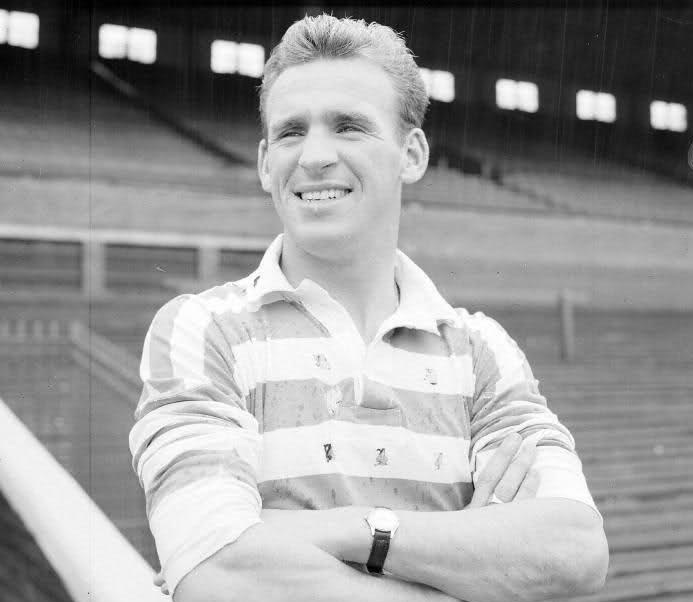
And yet, a more detached look at things might have presented a more favourable picture of Pat. He was no “Judas” in the sense that Maurice Johnston would be. He was more like Kenny Dalglish or Charlie Nicholas who, quite simply, wanted to sample life in England. The difference however was that both Dalglish and Nicholas had experienced success with Celtic, in Dalglish’s case a considerable amount of success, whereas Crerand had won nothing. He was fed up of being the star man in a good team.
He also saw that Celtic were heading absolutely nowhere under Bob Kelly. There was a death wish about the club with no great or obvious ability or even (at Director level) desire to overtake Rangers Had Crerand stayed around until Jock Stein came back in 1965, it would of course have been a totally different story, but as it was, Pat went on to win trophies for Manchester United, playing for Matt Busby. Both Busby and Crerand on a Saturday after a game would ask each other “How did Celtic do today?” as all Celtic supporters did!
None of this excuses in any way Crerand’s behaviour on New Year’s Day. Clearly some disciplinary measures needed to be taken against him, but as far as Celtic were concerned, accepting 55,000 for their star player (and not replacing him with the money) betokened a miserable lack of ambition at the club. The bitter harvest of this move would be reaped on the lonely, empty, desolate East Terracing of Hampden on the night of May 15. All that was missing that night was the tumbleweed of the ghost towns that we saw on the American cowboy movies!
Celtic were able to play a few games in February in Ireland where the weather was not so bad, but they only started playing serious football again when the thaw came with devastating speed causing landslides and flooding throughout Scotland in early March. Gallagher was not listed either at outside right nor inside left when football restarted with a game against Airdrie on 2 March. Presumably this was because of a belief that the ground would be too heavy for Charlie’s delicate touch, but his next game was against, of all teams, Gala Fairydean in the Scottish Cup at Parkhead on Wednesday 13 March after Celtic had beaten Hearts in the same competition the previous Wednesday.
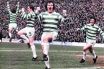
Gallagher played on the right wing as they won 6-0, was then dropped, played again, dropped again and was then picked for the infamous game at Kilmarnock where a makeshift team lost 0-6, one of the club’s biggest ever hammerings. There were allegedly six injuries and Celtic were fairly obviously keeping all their injured or recovering men for the Scottish Cup game at St Mirren on the Saturday, the Scottish League challenge having
long been abandoned.
Admittedly after such a long lay-off, there were bound to be a lot of knocks and injuries as everyone was playing two games per week, but the Celtic team selection policy (if there were such a thing), frankly defied analysis.
It baffled supporters then and continues to do so now well over 50 years later. It cannot have helped the confidence of these youngsters and it is no surprise that results were haywire. Gallagher did not play in the Glasgow Cup final on 8 April when an inept Celtic team were beaten 2-1 by Third Lanark, but he was brought back for the Scottish Cup semi-final against Raith Rovers at Ibrox on 13 April Raith Rovers were heading inexorably for relegation after many honourable years in the top tier, and this semi-final, played on a dry but windy day at
Ibrox, was probably one of the worst ever seen.
The standard of play was dreadful but Celtic did win 5-2 to earn a place in the first Old Firm Scottish Cup final since 1928, Rangers having beaten Dundee United by the same score 5-2 at Hampden. Gallagher played at inside left and was no worse than any other player that day. He might have, in view of Celtic’s victory, hoped to hold on to his place for a few games, but this was the last game that he played this season. Frankly, it defied analysis.