Bob Kelly was the son of James Kelly, the man who was brought from Renton in 1888 to launch this new venture called the Celtic or the Keltic. Bob Kelly could not therefore have been more anchored into the concept of Celtic. He had never played football himself – his withered arm put paid to that – but he had nevertheless dedicated his life to the club. His problem was that he seemed to take everything personally. There were several players – Neil Mochan, Bobby Collins, Bertie Auld, for example – that he simply did not like and this had nothing to do with their undoubted footballing ability in all three cases. He therefore wasted no opportunity to keep them out of the team even when, for footballing reasons, they should have been included. And of course, he picked the team. As someone put it rather accurately, the club was firmly led, but not necessarily in the right direction. He was virtually a dictator.
However, that may be, Kelly decided that the same team that failed so narrowly and so heartbreakingly at Tannadice should play in the first Old Firm game of the season when Rangers came to Parkhead on Saturday 8 September. A couple of days after that, on the Monday, Celtic had their friendly against the prestigious Real Madrid, for it had been one of Mr Kelly’s brighter ideas to invite them back to Glasgow, a city which still talked in glowing terms about their performance against Eintracht Frankfurt in the European Cup final of 1960 at Hampden.
But Rangers came first. They had qualified for the League Cup quarter finals, but not without a struggle and not without a few performances that were tactfully described as “indifferent”. But an Old Firm game has a momentum of its own, and a 70,000 crowd assembled on a warm sunny day to see the two Glasgow rivals. Charlie Gallagher’s direct opponent that day was no less a person than Jim Baxter, and it would be fair to say that honours were equal in that particular competition with neither Baxter nor Gallagher being able to impose himself on the play. But for Celtic it was another heartbreak.
The game hinged on a penalty awarded to Celtic on the half hour mark. Pat Crerand had been fouled and it was Pat who decided to take the kick. He allowed himself to get involved in some badinage about where the ball should be placed with Baxter and some other Rangers defenders. Crerand even at one point invited the Rangers players to place the ball on the spot for him. He then had the mortification to see goalkeeper Billy Ritchie save his kick. It had been the second crucial penalty kick that Pat had missed in two weeks.
But even at that, Celtic were still fractionally the better team until very late in the game when Willie Henderson shot for goal and Jim Kennedy in trying to clear simply knocked it into the net. It was another galling way in which to lose a game, and particularly after last week, it was simply too much to take, especially when Celtic supporters knew that the talent was there. Some call it professionalism, others call it luck. Whatever it was Celtic did not have it. Rangers on the other hand had both.
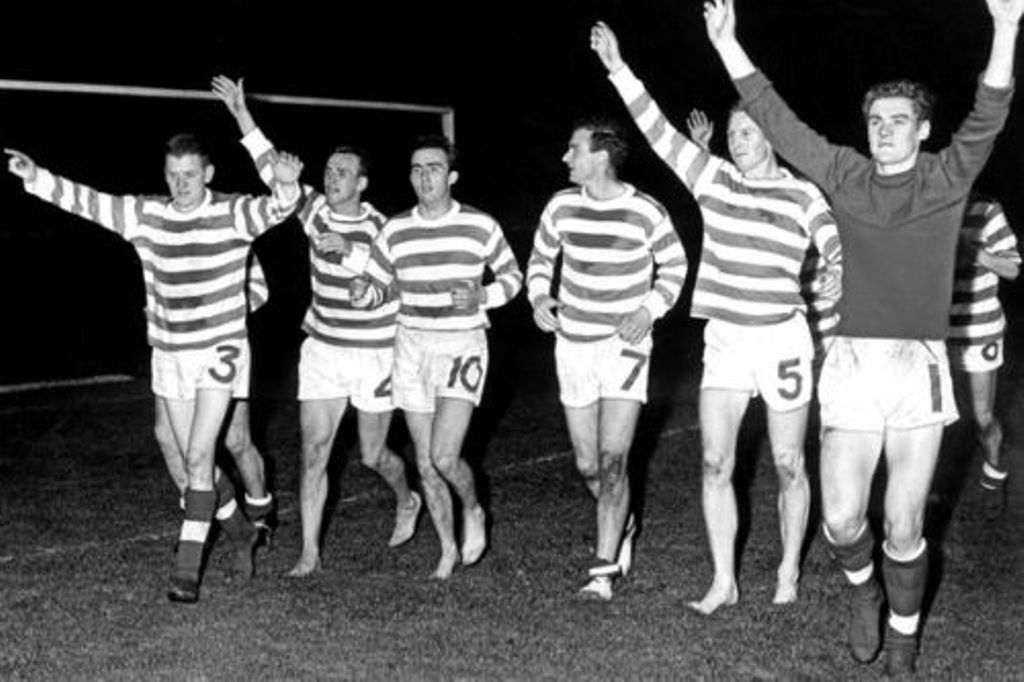
The Real Madrid game was a happier one, even though Celtic lost 3-1, for it was a fine game of football with Gallagher’s passing by no means out of place in such distinguished company. Ferenc Puskas went out of his way to praise the Celtic fans for their enthusiasm and the atmosphere that they produced. It was noticeable that when Celtic were allowed three substitutes at half-time (such things were only permitted by negotiation in Friendlies in 1962), Gallagher was not one of the three men taken off.
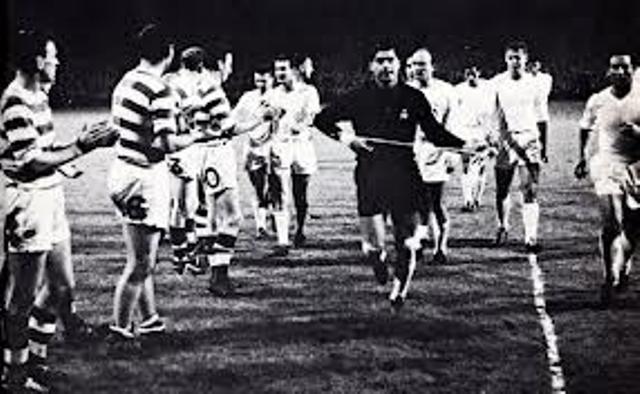
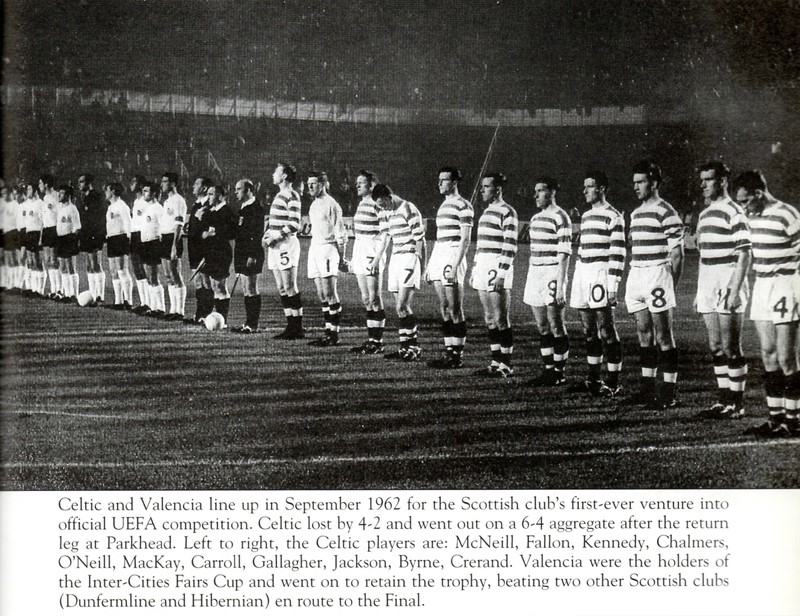
September saw Gallagher play in a good game against Clyde at Shawfield but then he was dropped for the game against Aberdeen when the Dons, by no means a great side in 1962, hushed a large Parkhead crowd by winning 2-1. But then he went to Spain to play against Valencia in Celtic’s first ever European adventure – a 2-4 defeat, as it turned out, but very much a learning experience.
Charlie has some vivid but not too happy recollections of his time in Spain “For some reason we were staying in what I can only describe as beach huts or cabins down next to the beach. The night before the game, there was quite a bad storm and the entire place was flooded. I don’t know why we were staying where we were, but we were effectively evacuated in the middle of the night. We had to change accommodation and to this day I don’t know if it was a bit of gamesmanship from the locals or not.
Put it this way, the weather conditions must have been forecast so why we were based there I just don’t know. I’d say I probably remember all of that more than the game itself…It was a big round stadium, like a bullring actually, and we were the bulls being intimidated by the matadors. It was a really intimidating venue. In fairness, we weren’t used to it. It was obviously our first European tie and we really didn’t know what to expect. It was like an adventure for us.”
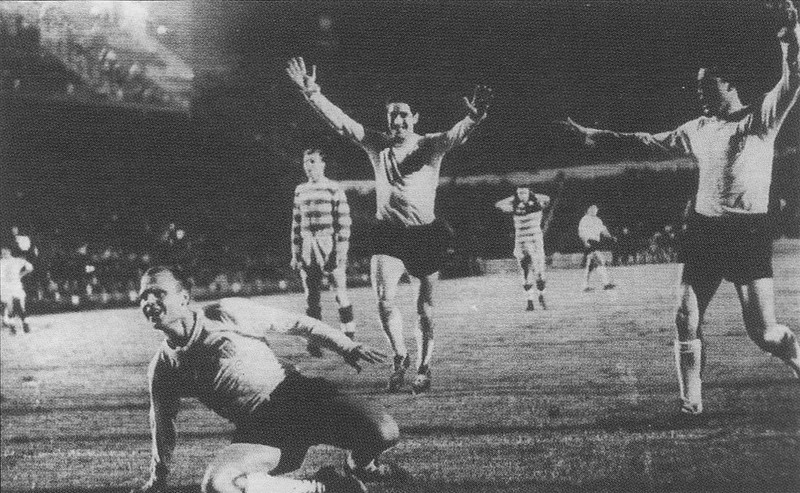
As autumn and winter descended in 1962, Celtic fans were increasingly baffled by team selections and team performances which sometimes seemed to lack any kind of logic. A new player called Bobby Craig was signed from Blackburn Rovers and he more or less got off the train at Glasgow Central, was taken in a taxi to Celtic Park and then played in the second leg of the European tie against Valencia a few hours later! Hardly surprisingly, this was less than a total success and that night saw Celtic’s first exit from a European Cup competition, the quaintly named Inter Cities Fairs Cup. Valencia went on to win the trophy that year.