The Danish champions are a mixture of the old and the new, having been formed in 1992 as a result of a merger between two existing clubs, Kjobenhavns Boldklub (KB) and Boldklubben 1903 (BK1903). KB lay claim to being the first football club to be established on continental Europe, playing their initial game in 1879, and remain the most successful side in Denmark, with fifteen national championships. BK1903 caused a minor sensation in September 1971, when they beat Jock Stein’s Celtic 2-1 in the first leg of their first round European Cup tie at the Idraetsparken, home of KB and the national team.
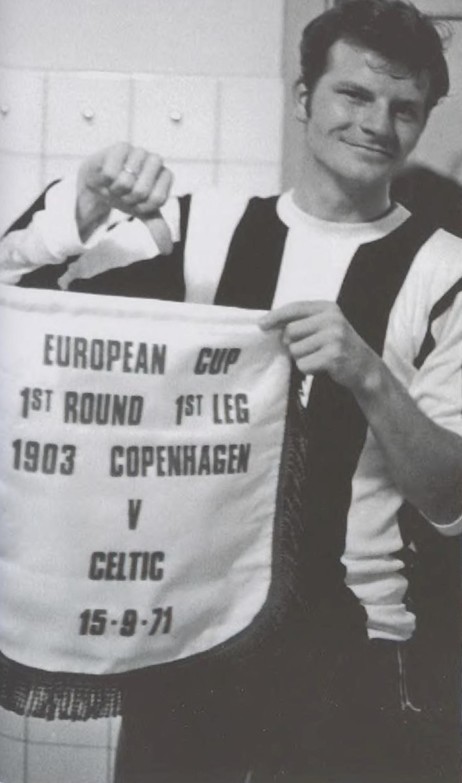
It was a display described by the Celtic manager as ‘the worst-ever in Europe’, despite the fact the squad of twelve who took part included seven Lions plus Kenny Dalglish, George Connelly and Lou Macari. This would be the second and final appearance in the Celtic goal of Gordon Marshall, following his debut in the Drybrough Cup semi-final at Firhill the previous month, where he had shipped two goals to Saint Johnstone, before a hat-trick from the rising star, Dalglish, saved the day.
Regular keeper, Evan Williams had been dropped by Stein for losing two goals at Ibrox the previous weekend, despite the fact that his side had won their third game there in 28 days! Tommy Callaghan was the other Celt yet to be mentioned here, his fine run and cross setting up Macari for an equaliser, the only highlight of the Hoops’ night. Both Danish goals were scored by outside-left, Benny Johansen. In a strange quirk of fate, he would become the first manager of the newly-formed FC Copenhagen in 1992.
Those opening few months of 1971/72 had been dramatic, highlighting transition on and off the field. July had seen the emergence of the young Dalglish as a first-team player and the death of a man who had been the darling of the Celtic support in the fifties, the one-and-only Charles Patrick Tully, just 47.
A magnificent, newly-refurbished, main stand was taking shape, opened on the first day of September against Uruguayan champions, Nacional, by another legend, Jimmy McGrory, Celts celebrating with a fine 3-0 victory in front of 60,000 fans.
The old guard was moving on, Stevie Chalmers joining John Clark in the blue-and-white hoops of Morton the same month, the fourth of the Lions to leave Celtic, following Ronnie Simpson’s retirement and Bertie Auld’s move to Easter Road in the close-season.
Both Chalmers and Clark would then make an immediate and nostalgic return to Parkhead, just three days after the defeat in Copenhagen, with Luggy taking nostalgia a step too far by scoring his final goal for Celtic, deflecting a Lou Macari effort past former-Rangers keeper Erik Sorensen, to give the hosts a 2-1 lead.
The following Tuesday saw the death of Celtic chairman, Robert Kelly, a director since 1932, upon the passing of his father James, the club’s first captain and superstar, Kelly junior then becoming chairman fifteen years later. He would be succeeded in that role by club secretary, Desmond White.
The day after Bob Kelly’s death saw the debut of 16-year-old Brian McLaughlin, in the second leg of a League Cup quarter-final tie against Clydebank at Celtic Park. McLaughlin was a wonderful player, and he may have gone on to fulfil his promise as the successor to Dalglish, had fate and William McVie not intervened two years later, the Clyde defender effectively ruining his career with a brutal challenge.
The following midweek, I was one of 53,000 making their way to Celtic Park for the return leg with BK1903 on a wet, miserable night. It was my third European game – following victories over Finland’s Kokkola and Ireland’s Waterford United the previous season – and it took place on the eleventh birthday of my late friend, Davie, mentioned earlier.
The 9-0 win over Kokkola had been played on my big cousin’s tenth birthday, a young yellow-clad substitute called Paul Wilson scoring his first two goals for Celtic. It’s funny the things which stick in your mind, even after all these years. Stein’s side had lost out in that first European season for yours truly to eventual winners, Ajax of Amsterdam, thus missing the opportunity of a second successive final, this time at Wembley. Can you begin to imagine that?