
One League game remained. It was against St Mirren and the attendance was described as “sparse”. Gallagher was played at inside left. Celtic scored three goals in the first half, then conceded three in the second in what was described as “an entertaining game” as the season limped to its conclusion. There remained the Glasgow Charity Cup games but by then Gallagher had dropped out of the side. He would be kept for next year, though.
Thus ended Gallagher’s first season. It was also the beginning of the momentous 1960s. Yet even as summer came, it was difficult not to get a little depressed about Celtic. Evans would soon be on his way to Chelsea leaving only Bertie Peacock and Neil Mochan of the 7-1 side which had been dismantled with astonishing speed since their great day of October 1957. Even they would soon be gone as a new team began to emerge. It would take time, we were all aware, but it was as well that we did not know what the next two or three years would bring.
Ironically it was probably a good era for football in general. Rangers were emphatically not getting their own way. This was because, frankly, they were not really all that good. They were quite lucky to win the Scottish Cup beating Kilmarnock in the final. Hearts had won the League and the League Cup, and in recent years, teams like St Mirren, Falkirk and Clyde had won the Scottish Cup. The national side were respectable at least, and attendances remained high, although there were definite signs that the “affluent society” as it would soon become to be called was showing working men that there were other ways of spending a Saturday afternoon than at a rundown stadium, sometimes with no cover or shelter from the grim Scottish rain, and with inadequate health hazard toilets.
It also seemed that clubs did not realise that such women as attended games might need the toilet as well occasionally! Scottish football was slow to spot these signs and to be pro-active. It would be punished when the fans began to stay away.
Celtic Park, for example, was far from a “dear old Paradise” in 1960. The stand had been built in 1929 and was adequate, but on the far side of the park was the “Jungle” – a hideous barn-shaped monstrosity first opened
in 1907 with holes in the roof and toilets which gave off a foul stench of urine and beer. Behind the railway end was a black shelter with windows at the back which were always broken and no-one had ever thought of mending them. It did not have holes in the roof, but it only came halfway down the terracing! It was built recently, but quite clearly on the cheap.
At the other end, there was nothing at all in the way of cover. The floodlights were indeed impressive but they shone down on mediocre football and inadequate facilities. But we still loved the Celtic! Life would have to get
better, but Gallagher was retained. This was very much part of the youth policy, and we kept hearing words like “promising”, “developing” and “maturing”. The future, Mr Kelly kept assuring us, was going to be a rosy one, once the fruits of the youth policy became apparent.
Listening to older supporters was at once illuminating but yet disheartening. There were still a good few left who had seen Young, Loney and Hay of the Edwardian era, and everyone’s father seemed to go on for ever about
Patsy Gallacher and Jimmy McGrory. It was all great to listen to, but the contrast between these great men and what was happening at the moment was stark and depressing. Yet there was the classical story of Pandora’s
Box which released all the ills of the world – but also Hope.
And there was on 18 May 1960 an example on our very doorstep of the way that football should be played. This was the European Cup final at Hampden between Real Madrid and Eintracht Frankfurt, often described as the best game of football ever played at Hampden Park. The game was televised as well, and Real Madrid won 7-3 with Puskas, Ghento and di Stefano at their glorious best. Even the inveterate lovers of Patsy Gallacher and Jimmy McGrory had to admit that Real were at least as good as these two demigods!
David Potter
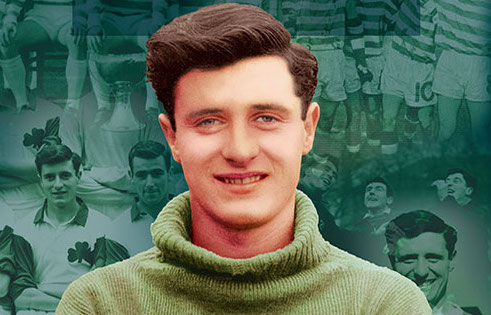
From David Potter biography published in 2016 – Charlie Gallagher? What a Player! Here is a Q&A session with Charlie when the book came out where he answers a selections of questions from Celtic Supporters…
CHARLIE’S Q&A…Gallagher is a name synonymous with Celtic, so shall it always be in Charlie’s case


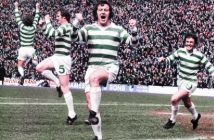
Charlie was the original man with the golden boot, he could ping a forty yard pass with such precision.Lovely man and a truly great Celt.