
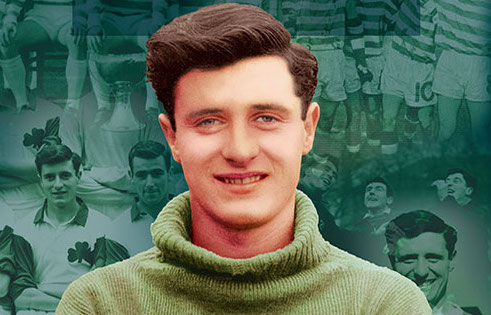
It was at a particularly dark hour of Celtic’s history that Charlie made his debut for the first team. The start of the 1959/60 season could hardly have been worse. By 22 August, they were already out of two Cups. Drawn in a League Cup section of Raith Rovers, Partick Thistle and Airdrie, one might have expected Celtic to emerge victorious, but they had already lost their first three games and were in the humiliating position of being the only one of the four unable to qualify!
They had also lost 2-1 to Rangers in the Glasgow Cup – a result that was at least respectable, if massively
disappointing – and their only win of the season had been a 2-0 win over Kilmarnock, ironically Kilmarnock being the best ranked of all the teams they had played so far!
“Parkhead is more like Purgatory those days” said Gair Henderson in The Evening Times and even in the wake of the win over Kilmarnock, Celtic were badly hit by injuries to Bobby Carroll, Neil Mochan, John Divers and Mike Jackson, and a debut was given to Charlie Gallagher “the boy from Yoker”. It was of course part of the “youth policy” that the “Kelly Kids” were gradually to be weaned into the first eleven.

The opponents Raith Rovers who were off to a good start to the season and were enjoying one of the better periods of their history. They had reached three Scottish Cup semi-finals in the decade of the 1950s and were consistently highly placed in the Scottish League. The strength lay in their half back line of Young, McNaught and Leigh, commonly known as the “burglar proof” half back line. They were ageing now, but were still generally regarded as being one of the best in the business. Centre half Willie McNaught had played for Scotland 5 times, and right half Andy Young ought to have been capped.
He had played a couple of games for Celtic at the end of World War II but had been allowed to go, and Andy Leigh was also considered unlucky not to have been given some International recognition. Nevertheless, it is not often that Raith Rovers come to Celtic Park as favourites. This however was one such occasion.
The weather was hot, – indeed The Evening Times talks with a touch of hyperbole about “the Turkish bath atmosphere” at Parkhead for the 20,000 crowd – and this was maybe significant in the way that play was to unfold. A glance at the teams will show that Celtic were mainly young men, certainly in the forward line. Only three men – Mochan, Evans and Peacock – could be described as experienced, (they were also the only ones who had won any trophy) whereas Raith Rovers, including their venerable half-back line, was now approaching the veteran stage.
Of the eight youngsters, Haffey, McNeill, McKay, Gallagher and Auld could be said to have gone on and made some progress, even though Haffey and McKay are sadly always to be identified with Celtic failure, whereas Matt McVittie played 33 times for Celtic and had but one moment of glory in the Scottish Cup defeat of Rangers a few months
previously in 1959, Jim Conway played 32 times and was always described as a “promising” youngster even when he had stopped promising and was no longer young. Poor Dan O’Hara with 7 appearances was one of the many players of that era who never made it and simply disappeared. As one says “Many are called, but few are chosen”.
Celtic : Haffey, McNeill and Mochan; McKay, Evans and Peacock;
McVittie, O’Hara, Conway, Gallagher and AuldRaith Rovers: Drummond, Polland and McFarlane; Young, McNaught
and Leigh; Kerray, Conn, White, McKinven and UrquhartReferee : Mr T Alexander, Edinburgh
Celtic surprised the Press and delighted their fans by playing fast attacking football with inside forwards Dan O’Hara and Charlie Gallagher being singled out for their good work. Ironically the only goal of the game was
an own goal caused by a misunderstanding between McFarlane and Drummond in the Raith goal. Charlie had played a part in the build-up to this goal, teaming up with the great Bertie Peacock to release the speedy O’Hara. Press reports combine to praise Gallagher’s contribution, and it is interesting that the two things he is commended for are his passing ability and his “thunderbolt” shot – two things that he would become famous for in later years.
The game finished with a 1-0 victory which should in truth have been a lot more if Celtic had taken all their chances and if goalkeeper Drummond had not been in such fine form in the Raith Rovers goal. Cyril Horne in
The Glasgow Herald, a respected journalist and not normally given to exaggeration, even compares Charlie’s performance with some games of his late namesake Patsy Gallacher, generally reckoned to have been one
of the best players who ever lived.
“Not for many a day have I seen a player, young or old, make so many accurate long passes as did the new Gallagher against Raith Rovers. There is no more shrewd centre half than McNaught, yet he was clearly perplexed by the frequency with which Gallagher changed the direction of Celtic’s attacks by sweeping the ball right, left and centre”.
Following such an encomium of praise, it is perhaps surprising to find that Charlie never played another game for the first team until April of the following spring by which time everything had been lost. Yet it can readily be understood in the chaos that existed at Celtic Park as far as team selection went. Jock Stein was still at Celtic Park but worked more with the reserves than the first team, the nominal Manager was Jimmy McGrory, an immortal centre forward in his day but far too nice a man to be Manager, and the power lay in the autocratic and sometimes arrogant hands of Bob Kelly an “inveterate meddler” who seemed to change the team almost on a whim, as if it were some kind of a hobby.

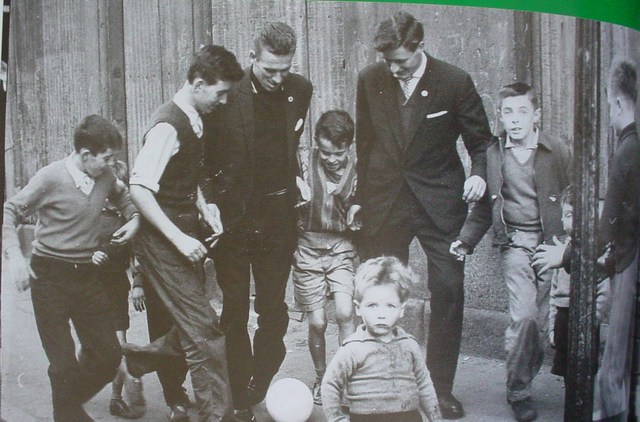
The men who had been injured before the Raith Rovers game all came back, and there was no place for Gallagher in the game against Partick Thistle on Wednesday night, a game played in a slightly surreal atmosphere for Partick Thistle’s manager Davie Meiklejohn had died suddenly after their game against Airdrie on Saturday. Meiklejohn, of course had been one of Rangers best ever players in the 1930s, and all of Scottish football have been stunned by this event, for he was only 58. To their credit, apart from one or two idiots, the Celtic supporters treated Meiklejohn’s memory with respect. It had been Meiklejohn who had read the lesson at the funeral of John Thomson in 1931.
Charlie possibly did well to miss this game, but it is still hard to explain why, as the form of the team stuttered and started, and never really rose above the mediocre all season, he never was given another game for so long. Inside left was John Divers, son of the John Divers who had graced the Empire Exhibition Trophy winning side of 1938, but even when Divers was out of the side, his place was given to Neil Mochan.
But Gallagher was in the Reserve team which would go on to win the Reserve League and the Reserve League Cup, and he continued to learn his trade there, as a good nucleus of players began to gather. Gallagher himself was quite happy, for he enjoyed playing with the second eleven.
As far as the first XI was concerned, the impression began to be given that, although this was a bad season, long term prospects for success were good. This, at least, was the way that supporters cheered themselves up, but it was Celtic who were clearly the losers in season 1959/60. Out of the Scottish League Cup and Glasgow Cup at an early stage, and nowhere in the Scottish League, won well by Hearts that year, was bad enough for the supporters to put up with, but even worse had been the asset stripping of men like Willie Fernie and Bobby Collins and eventually Bobby Evans at the end of the 1959/60 season. These were men who, as the future would prove, had years of football left in them.
Willie Fernie, of course, would come back after a sojourn with Middlesbrough playing alongside Brian Clough and Bobby Collins won a Scottish cap as late as 1965! A great deal of this was to pay, apparently, for the floodlights, quite clearly the best in the land but as great journalists like Cyril Horne, John McKenzie and Gair Henderson and indeed all the fans kept asking, what is the point of having great floodlights if you can’t even make it into Europe to use them to their full potential?
The floodlights were switched on for the first time on Monday 12 October 1959, impressing everyone as being possibly the best in Britain, an opinion shared by the visiting Wolverhampton Wanderers side. No-one
could possibly say however that the Celtic team was anything like the best in Britain, for Wolves, winners of the English League for the past two seasons and who would go on to win the English Cup in 1960, simply swept Celtic aside and quite clearly stopped at 2-0 when they could have really embarrassed Celtic on a night that should have been a great occasion for them.
All this time Gallagher was learning his trade as best as he could in the chaotic circumstance of Celtic Park. Celtic had three teams – the first XI, the reserves who played in the Scottish Reserve League and a third team
who played in a Combined Reserve League. Sometimes he would play in one or other of the reserve teams – but Celtic had such a huge squad of youngsters that this could not be guaranteed, and sometimes he was allowed to play for a Junior team.

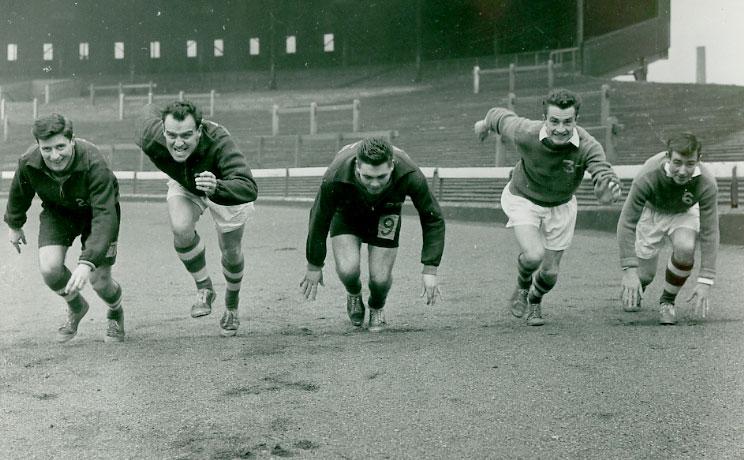
He did however enjoy the intensive training sessions that the team had at Seamill Hydro. He tells of one occasion when the bus taking them there suddenly stopped at Dalry, a mile or two short of the Seamill Hydro. The bus would continue to Seamill with all the equipment, but the players in the interests of fitness were invited to walk the rest of the way. There were a few protests, but then Eric Smith and Bertie Auld, two gallus, cocky, cheeky chappies told the rest of them not to worry, for they knew a short cut. Not for the last time in Charlie’s life did he learn the lesson that listening to Eric Smith and Bertie Auld was not necessarily a good idea. A long trek through farm yards, fields with cows in them, crossing rivers, climbing hills followed, and however much Smith and Auld
denied it, they were lost – until the bus came looking for them! It would have been greatly embarrassing if the mighty Celtic FC had disappeared in rural Ayrshire!
In March 1960 Jock Stein left Celtic Park. No-one realised the significance of this at the time, indeed it did not make headline news, but this move would have spectacular ramifications. Everyone felt that Jock might make
a good Manager and were delighted when Dunfermline Athletic, in one of their seemingly perennial battles against relegation, appointed him Manager. His first game as Manager of the Pars was against Celtic at East End Park on 19 March and they won 3-2! He would eventually rescue the Pars from the drop to Division Two at the end of the season.
The departure of Jock Stein made little difference to Charlie Gallagher who felt that he suffered perhaps through not being a Stein signing.
Charlie was still plying his trade in the reserves who were playing excellent football and had defeated Dunfermline Athletic reserves 5-1, for example, at Parkhead on the Friday night before the first team lost at East End Park.
The Celtic Park floodlights, of course, allowed the reserves to play at a sensible time on Friday night, and the team were rewarded by reasonable crowds turning up to watch them. The catalyst for Charlie’s return to
the first team was another of Celtic’s many horror stories that were so prevalent at this dark hour of our history.
Celtic had needed three matches to dispose of St Mirren, but had eventually done so en route to the Scottish Cup semi-final on 2 April to play Rangers. Rangers themselves were not enjoying the best of seasons, clearly being second best to Hearts in the League, and it was felt that the inconsistent Celtic did at least have a chance. The first game against Rangers had been a respectable 1-1 draw with a fine header by young Steve Chalmers to put Celtic in the lead.

The replay kicked off at 4.30pm (Hampden still had no floodlights) on Wednesday 6 April, and this time Celtic just collapsed in the second half after seeming to have done the hard bit by coming off at half-time having faced the wind and the strong spring sun at 1-1. In retrospect (always easy!) it might have been better if Celtic had given a game to Charlie Gallagher that night, for left winger Alec Byrne was injured as indeed was Bertie Auld. Celtic
put John Divers on to the left wing and brought in at inside left Mike Jackson, a naturally right sided player.
The irony was that this was no great Rangers side. They were virtually out of the League race and were about to undergo a spectacular thrashing from Eintracht Frankfurt in the semi-final European Cup, yet they were clearly so much better than Celtic. Celtic’s season had now collapsed and the management belatedly, perhaps, decided that more changes were needed, and that the impressive young Charlie Gallagher should be given a run in the team.
It was thus when Celtic were once again on their knees that Gallagher played his second game for the club. Indeed, he would play in the four remaining, little-at-stake games of the season before low crowds with those fans who were there not slow to vent their annoyance and frustration at what was going on. Only 5,000 for example appeared at Parkhead on 12 Tuesday April to see Celtic go down 2-4 to Partick Thistle. The defeat was actually even worse than it seemed, for Thistle were 4-0 up at one point, and only a handful of spectators were left to see Celtic’s two late goals.
They did not even have the strength to stay and boo, and poor Charlie Gallagher on the left wing had the indignity of not having his name mentioned at all in the next day’s newspapers, which were in any case full of Rangers’ game in Germany against Eintracht Frankfurt.
Nevertheless, Charlie was given another run against Dundee at Dens Park on the Saturday. It was a desolate experience with once again Celtic marginalised in the newspapers, for Hearts hogged the attention with their winning of the League that day in a 4-4 draw against St Mirren at Love Street. At Dens Park, Dundee won 2-0 with a goal from a talented youngster called Alan Gilzean and another from Hugh Robertson before half time with the minuscule Celtic support either drifting away to enjoy the local hostelries or just sitting on the terracing drinking beer and even a few of them horrifying the war veterans with a chorus of “Deutschland Uber Alles” in honour of Eintracht Frankfurt’s 6-1 hammering of Rangers on Wednesday night – “Aye, and it should have been 26”, said a toothless, unshaven, smelly individual beside me.
But this was not Celtic in any way, shape or form. Young Gallagher did now and again earn a round of applause for a good run or a telling pass, and because of his youth was generally exempt from the barracking that was directed at men like Eric Smith and John Divers. Yeterans like Bobby Evans and Bertie Peacock, great players in their day, really did look old that day. Celtic fans often misbehaved in Dundee in those days. Not today however. There were not enough of them, and those who were there were simply too disheartened to throw bottles. They ended up talking to the Dundee supporters and agreeing with them that both teams had seen better days.
But one of the fascinating things about teams in transition is their unpredictability. Celtic then went to Airdrie on the Monday afternoon – it was the local holiday and Easter Monday into the bargain – and thrashed Airdrie 5-2 with Steve Chalmers getting a second half hat-trick and Charlie’s cousin Pat Crerand getting a game and playing brilliantly.
Charlie himself played well, although perspicacious Celtic supporters perhaps wondered whether left wing was the best place for him because he did not seem to be the speediest of players, and his passing ability seemed to indicate that the centre of the field might be a better option. Still, it was a great feeling to trot off in the spring sunshine with a win to the team’s credit for once.
One League game remained. It was against St Mirren and the attendance was described as “sparse”. Gallagher was played at inside left. Celtic scored three goals in the first half, then conceded three in the second in what was described as “an entertaining game” as the season limped to its conclusion. There remained the Glasgow Charity Cup games but by then Gallagher had dropped out of the side. He would be kept for next year, though.
Thus ended Gallagher’s first season. It was also the beginning of the momentous 1960s. Yet even as summer came, it was difficult not to get a little depressed about Celtic. Evans would soon be on his way to Chelsea leaving only Bertie Peacock and Neil Mochan of the 7-1 side which had been dismantled with astonishing speed since their great day of October 1957. Even they would soon be gone as a new team began to emerge. It would take time, we were all aware, but it was as well that we did not know what the next two or three years would bring.
Ironically it was probably a good era for football in general. Rangers were emphatically not getting their own way. This was because, frankly, they were not really all that good. They were quite lucky to win the Scottish Cup beating Kilmarnock in the final. Hearts had won the League and the League Cup, and in recent years, teams like St Mirren, Falkirk and Clyde had won the Scottish Cup. The national side were respectable at least, and attendances remained high, although there were definite signs that the “affluent society” as it would soon become to be called was showing working men that there were other ways of spending a Saturday afternoon than at a rundown stadium, sometimes with no cover or shelter from the grim Scottish rain, and with inadequate health hazard toilets.
It also seemed that clubs did not realise that such women as attended games might need the toilet as well occasionally! Scottish football was slow to spot these signs and to be pro-active. It would be punished when the fans began to stay away.
Celtic Park, for example, was far from a “dear old Paradise” in 1960. The stand had been built in 1929 and was adequate, but on the far side of the park was the “Jungle” – a hideous barn-shaped monstrosity first opened
in 1907 with holes in the roof and toilets which gave off a foul stench of urine and beer. Behind the railway end was a black shelter with windows at the back which were always broken and no-one had ever thought of mending them. It did not have holes in the roof, but it only came halfway down the terracing! It was built recently, but quite clearly on the cheap.
At the other end, there was nothing at all in the way of cover. The floodlights were indeed impressive but they shone down on mediocre football and inadequate facilities. But we still loved the Celtic! Life would have to get
better, but Gallagher was retained. This was very much part of the youth policy, and we kept hearing words like “promising”, “developing” and “maturing”. The future, Mr Kelly kept assuring us, was going to be a rosy one, once the fruits of the youth policy became apparent.
Listening to older supporters was at once illuminating but yet disheartening. There were still a good few left who had seen Young, Loney and Hay of the Edwardian era, and everyone’s father seemed to go on for ever about
Patsy Gallacher and Jimmy McGrory. It was all great to listen to, but the contrast between these great men and what was happening at the moment was stark and depressing. Yet there was the classical story of Pandora’s
Box which released all the ills of the world – but also Hope.
And there was on 18 May 1960 an example on our very doorstep of the way that football should be played. This was the European Cup final at Hampden between Real Madrid and Eintracht Frankfurt, often described as the best game of football ever played at Hampden Park. The game was televised as well, and Real Madrid won 7-3 with Puskas, Ghento and di Stefano at their glorious best. Even the inveterate lovers of Patsy Gallacher and Jimmy McGrory had to admit that Real were at least as good as these two demigods!
David Potter
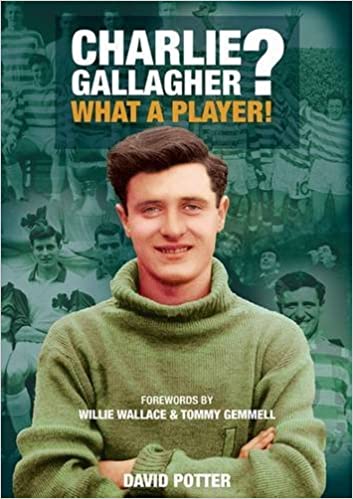
From David Potter biography published in 2016 – Charlie Gallagher? What a Player! Here is a Q&A session with Charlie when the book came out where he answers a selections of questions from Celtic Supporters…
CHARLIE’S Q&A…Gallagher is a name synonymous with Celtic, so shall it always be in Charlie’s case