
The men who had been injured before the Raith Rovers game all came back, and there was no place for Gallagher in the game against Partick Thistle on Wednesday night, a game played in a slightly surreal atmosphere for Partick Thistle’s manager Davie Meiklejohn had died suddenly after their game against Airdrie on Saturday. Meiklejohn, of course had been one of Rangers best ever players in the 1930s, and all of Scottish football have been stunned by this event, for he was only 58. To their credit, apart from one or two idiots, the Celtic supporters treated Meiklejohn’s memory with respect. It had been Meiklejohn who had read the lesson at the funeral of John Thomson in 1931.
Charlie possibly did well to miss this game, but it is still hard to explain why, as the form of the team stuttered and started, and never really rose above the mediocre all season, he never was given another game for so long. Inside left was John Divers, son of the John Divers who had graced the Empire Exhibition Trophy winning side of 1938, but even when Divers was out of the side, his place was given to Neil Mochan.
But Gallagher was in the Reserve team which would go on to win the Reserve League and the Reserve League Cup, and he continued to learn his trade there, as a good nucleus of players began to gather. Gallagher himself was quite happy, for he enjoyed playing with the second eleven.
As far as the first XI was concerned, the impression began to be given that, although this was a bad season, long term prospects for success were good. This, at least, was the way that supporters cheered themselves up, but it was Celtic who were clearly the losers in season 1959/60. Out of the Scottish League Cup and Glasgow Cup at an early stage, and nowhere in the Scottish League, won well by Hearts that year, was bad enough for the supporters to put up with, but even worse had been the asset stripping of men like Willie Fernie and Bobby Collins and eventually Bobby Evans at the end of the 1959/60 season. These were men who, as the future would prove, had years of football left in them.
Willie Fernie, of course, would come back after a sojourn with Middlesbrough playing alongside Brian Clough and Bobby Collins won a Scottish cap as late as 1965! A great deal of this was to pay, apparently, for the floodlights, quite clearly the best in the land but as great journalists like Cyril Horne, John McKenzie and Gair Henderson and indeed all the fans kept asking, what is the point of having great floodlights if you can’t even make it into Europe to use them to their full potential?
The floodlights were switched on for the first time on Monday 12 October 1959, impressing everyone as being possibly the best in Britain, an opinion shared by the visiting Wolverhampton Wanderers side. No-one
could possibly say however that the Celtic team was anything like the best in Britain, for Wolves, winners of the English League for the past two seasons and who would go on to win the English Cup in 1960, simply swept Celtic aside and quite clearly stopped at 2-0 when they could have really embarrassed Celtic on a night that should have been a great occasion for them.
All this time Gallagher was learning his trade as best as he could in the chaotic circumstance of Celtic Park. Celtic had three teams – the first XI, the reserves who played in the Scottish Reserve League and a third team
who played in a Combined Reserve League. Sometimes he would play in one or other of the reserve teams – but Celtic had such a huge squad of youngsters that this could not be guaranteed, and sometimes he was allowed to play for a Junior team.
He did however enjoy the intensive training sessions that the team had at Seamill Hydro. He tells of one occasion when the bus taking them there suddenly stopped at Dalry, a mile or two short of the Seamill Hydro. The bus would continue to Seamill with all the equipment, but the players in the interests of fitness were invited to walk the rest of the way. There were a few protests, but then Eric Smith and Bertie Auld, two gallus, cocky, cheeky chappies told the rest of them not to worry, for they knew a short cut. Not for the last time in Charlie’s life did he learn the lesson that listening to Eric Smith and Bertie Auld was not necessarily a good idea. A long trek through farm yards, fields with cows in them, crossing rivers, climbing hills followed, and however much Smith and Auld
denied it, they were lost – until the bus came looking for them! It would have been greatly embarrassing if the mighty Celtic FC had disappeared in rural Ayrshire!
In March 1960 Jock Stein left Celtic Park. No-one realised the significance of this at the time, indeed it did not make headline news, but this move would have spectacular ramifications. Everyone felt that Jock might make
a good Manager and were delighted when Dunfermline Athletic, in one of their seemingly perennial battles against relegation, appointed him Manager. His first game as Manager of the Pars was against Celtic at East End Park on 19 March and they won 3-2! He would eventually rescue the Pars from the drop to Division Two at the end of the season.
The departure of Jock Stein made little difference to Charlie Gallagher who felt that he suffered perhaps through not being a Stein signing.
Charlie was still plying his trade in the reserves who were playing excellent football and had defeated Dunfermline Athletic reserves 5-1, for example, at Parkhead on the Friday night before the first team lost at East End Park.
The Celtic Park floodlights, of course, allowed the reserves to play at a sensible time on Friday night, and the team were rewarded by reasonable crowds turning up to watch them. The catalyst for Charlie’s return to
the first team was another of Celtic’s many horror stories that were so prevalent at this dark hour of our history.
Celtic had needed three matches to dispose of St Mirren, but had eventually done so en route to the Scottish Cup semi-final on 2 April to play Rangers. Rangers themselves were not enjoying the best of seasons, clearly being second best to Hearts in the League, and it was felt that the inconsistent Celtic did at least have a chance. The first game against Rangers had been a respectable 1-1 draw with a fine header by young Steve Chalmers to put Celtic in the lead.

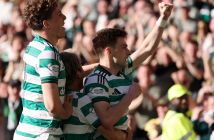
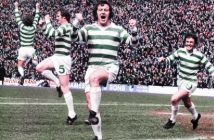
Charlie was the original man with the golden boot, he could ping a forty yard pass with such precision.Lovely man and a truly great Celt.