6. EMPIRE EXHIBITION TROPHY
In 38 there was a show
Glasgow was the place to go
A model of the tower was football’s prize.
England sent four of the best
They didn’t meet with much successful
For the trophy ended up in Paradise!
This was a one-off tournament, played between four leading sides of Scotland and four leading sides of England, in late May and early June 1938, to commemorate the Empire Exhibition being held at Bellahouston Park, Glasgow. The Exhibition was to be ‘an exposition of the work, life, culture and progress’ of the British Empire, and was a much needed propaganda counterblast to what was coming from Nazi Germany.
As Glasgow, the ‘Second City of the Empire’, was frequently described as the football capital of the world, it was felt that a football tournament between eight invited sides would be a fitting part of the ‘work, culture, life and progress’ of Glasgow. A trophy was commissioned in the image of the Tait Tower, the symbol of the Empire Exhibition. All the games were played at Ibrox, because of its proximity to Bellahouston Park. Sadly, neither Arsenal (the English league winners) nor Preston North End (the FA Cup winners) took part, but the tournament was still hotly contested, and the winners could claim to be the champions of Britain.
Celtic needed a replay to dispose of Sunderland in the quarter-final (3-1 with goals from Johnny Crum and two from John Divers), while Aberdeen, Hearts and Everton were the other winners. Johnny Crum also scored against Hearts in the semi-final (the only goal of the game) before 52,000 fans while Everton squeezed narrowly past Aberdeen.
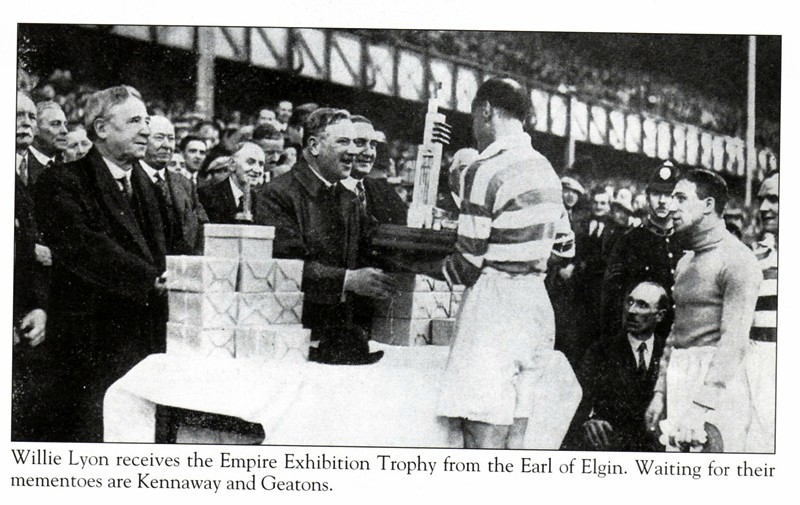
The final between Celtic and Everton was an epic between two great teams. “Fetch a polis man, Everton’s getting murdered” was the cry of the Celtic fans before the game, but the reality was quite different, for the game was tight and hard-fought, with a winner possible at either end. Celtic had Jimmy Delaney back from injury and his presence was probably crucial, although it was Johnny Crum who broke the deadlock when he scored the only goal of the game after seven minutes of extra time.
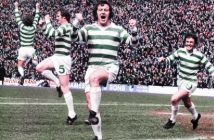
Famously, he then ran behind the goal and did a ‘Highland fling’ for the benefit of the fans. He had thus scored in every round. The second half of the game and the extra time was broadcast on radio on the BBC Regional Service, beginning at 7.50 pm, and the commentator was the Sunday Mail journalist Rex Kingsley. Johnny Crum, the hero of the hour, was married the following Wednesday.
It was a triumph much celebrated by Celtic fans, and it is a mystery why the team did not go forward from there. The club’s Golden Jubilee was celebrated a few days later, and it was confidently expected that the ageing Maley would announce his retirement but he failed to do so. The club then had a terrible season in 1938/39 and played through the Second World War with a distinct lack of success, and in was 1951 before a major Scottish honour was again won. So, although this was a great triumph, it also heralded the start of Celtic’s darkest days.
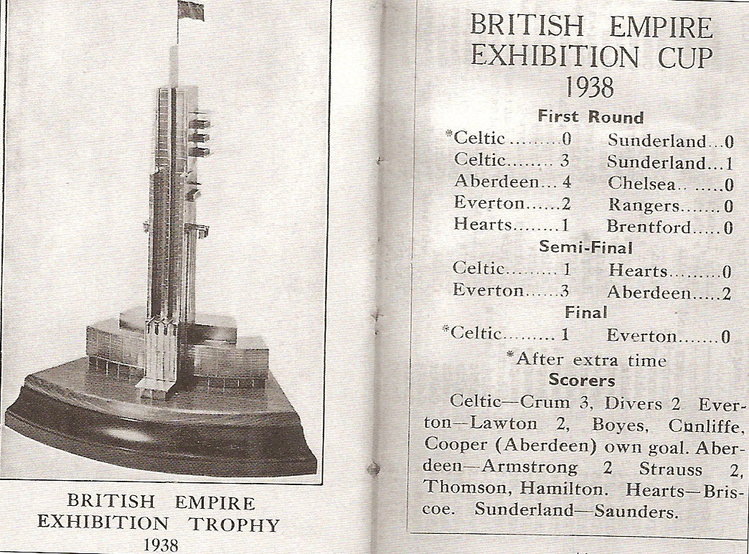
The teams were:
Celtic: Kennaway, Hogg, Morrison, Geatons, Lyon, Paterson, Delaney, MacDonald, Crum, Divers, Murphy
Everton: Sagar, Cook, Greenhalgh, Mercer, Jones, Thomson, Geldard, Cunliffe, Lawton, Stevenson, Boyes
Referee: T.Thomson, Northumberland
7. VERY WEE JIMMY JOHNSTONE
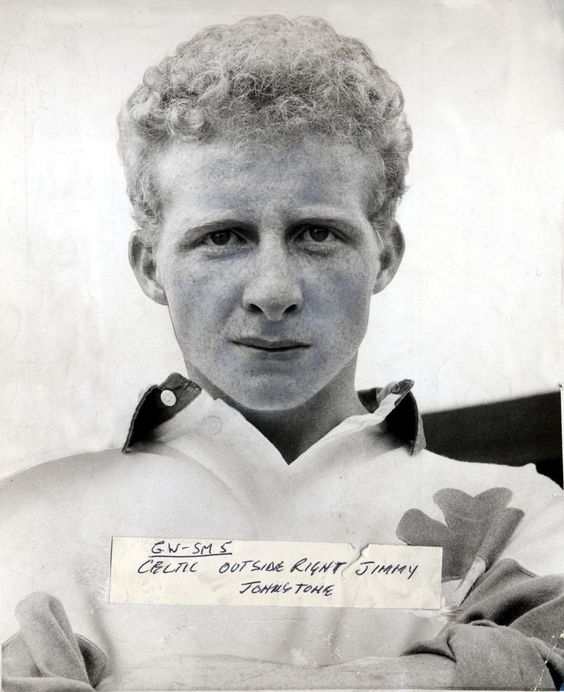
Everyone knew that he was small, and when he played in the first game of the 1963 Scottish Cup Final he impressed and was universally referred to as “wee Jimmy Johnstone”. But the week after that game, Celtic were at Tannadice Park to play Dundee United with the local fans all agog to see “wee Jimmy Johnstone”. A gasp arose from the crowd when a wee red-headed boy ran out with the team. “He’s surely not as small as all that!” No indeed, he wasn’t. This was the three year old mascot with read hair and his green and white strip, accompanying Billy McNeill. The “real” Jimmy Johnstone ran out with the rest of the team. He was still rather small, it had to be said, but a wheen taller than the three year old!
David Potter